Many parents proudly say that their child has always been strong in mathematics. In the primary years, especially in Grades 4 and 5, some children clearly display mathematics as a strength area. They are quick to grasp concepts, complete classwork with ease, and often appear confident with numbers. They may perform well in school assessments and are commonly described as being “naturally good at maths”.
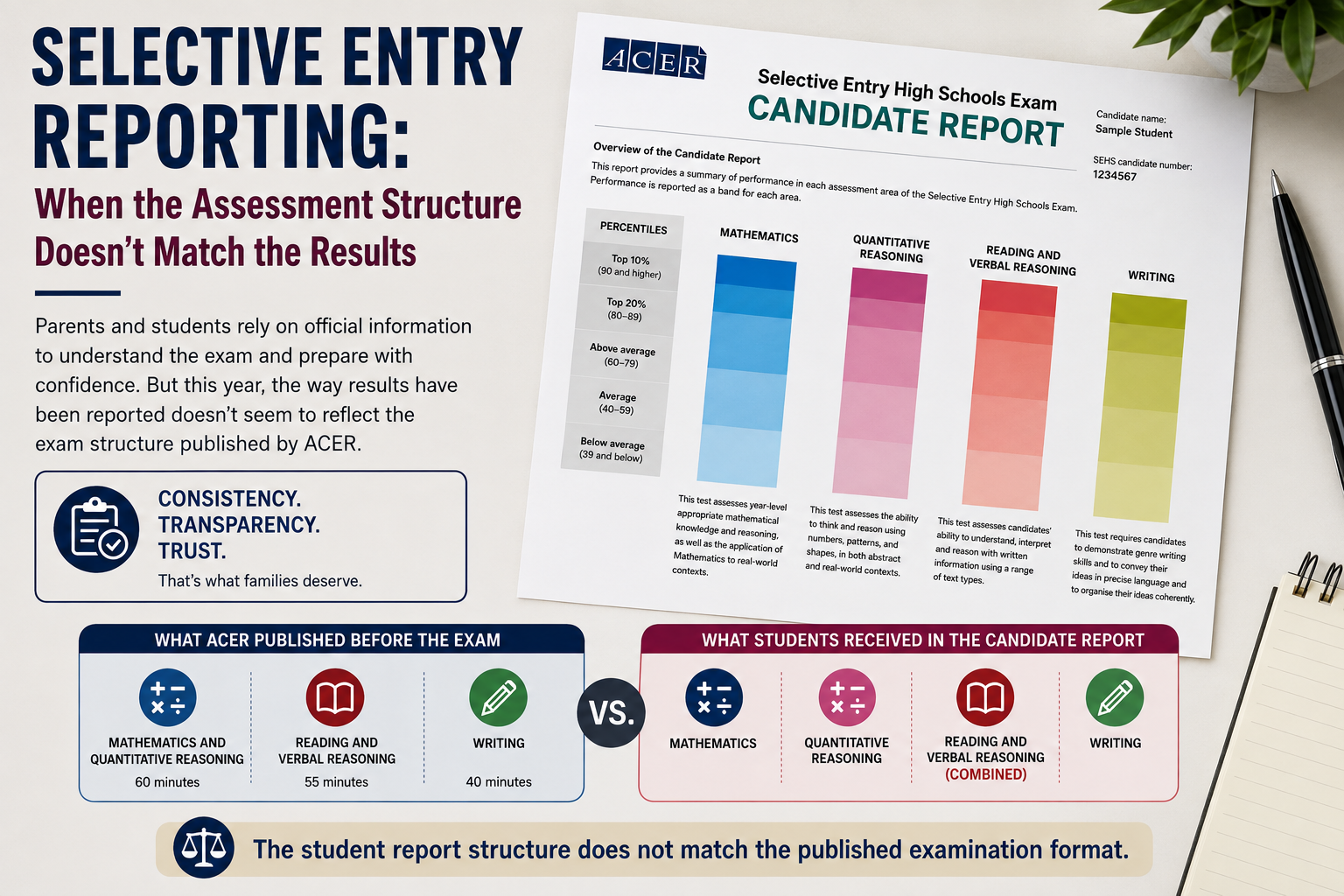
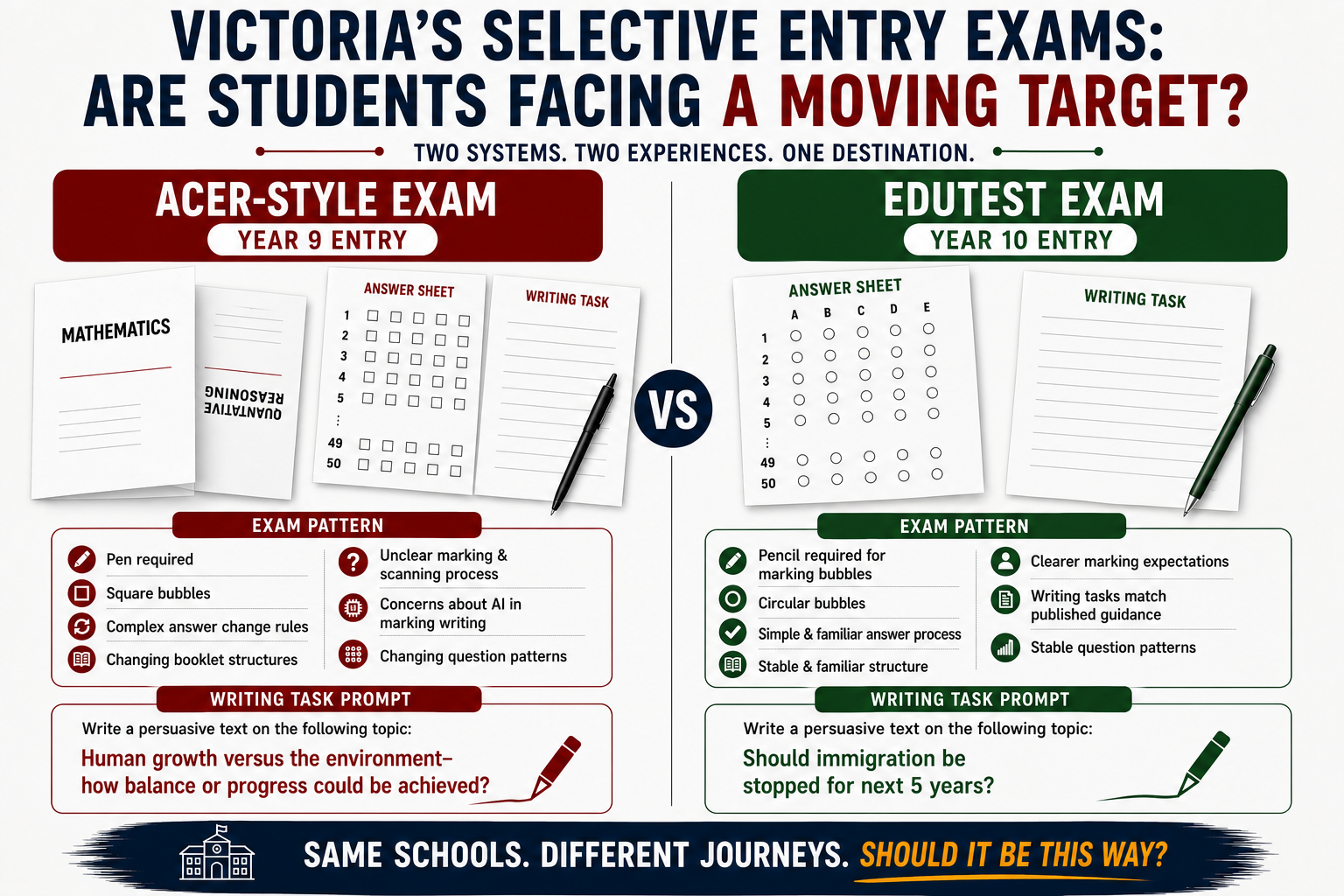
It is therefore quite understandable that parents expect these same children to continue showing strong mathematical calibre by the time they reach Year 8, particularly when preparing for competitive examinations such as Selective Entry, where Mathematics and Quantitative Reasoning form an important part of the assessment.
However, what we often observe is quite concerning.
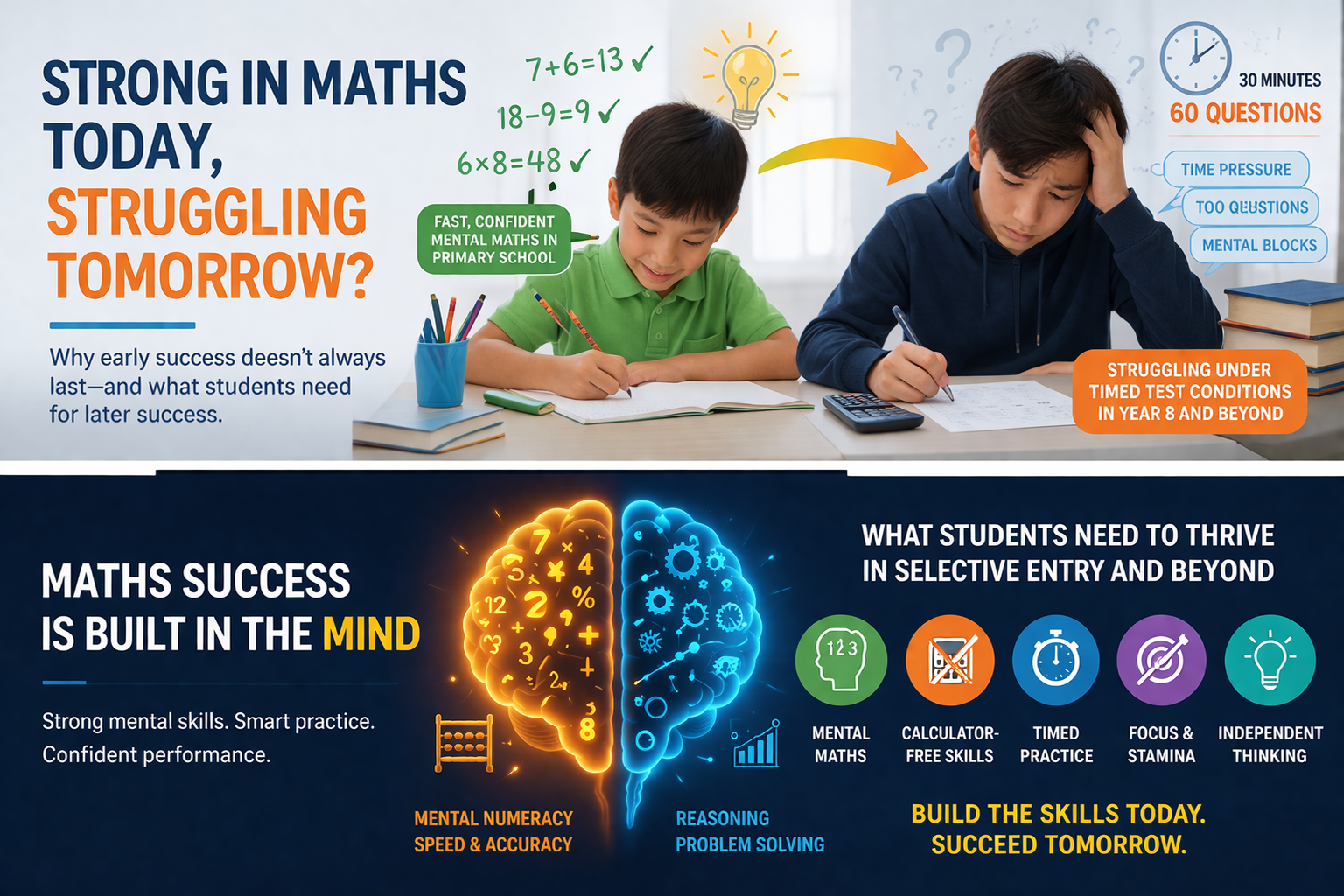
A significant number of students who were once considered strong in mathematics begin to struggle by the time they reach the selective entry stage. Many parents who previously believed maths to be their child’s strength later express worry that their child now seems weak in the subject. School reports may also begin to reflect this, advising that the child needs further improvement in mathematics. In selective entry preparation, such students are often unable to cope well under timed conditions, especially when they are required to attempt around 50 to 60 questions in only 30 minutes. Under such pressure, even students who know the concepts may fail to perform because they do not have the speed, fluency, and mental sharpness required.
Why does this happen?
One important reason may be the excessive reliance on calculators and digital technology in school and in everyday learning. When children become accustomed to using calculators for routine working out, they gradually use their own mental computation skills less and less. Over time, this weakens their ability to think quickly with numbers, estimate efficiently, recall number facts instantly, and solve problems mentally.
A child may still appear successful in a school setting where calculator use is common and time is generous. However, the same child may struggle in a competitive exam where calculators are not allowed and fast, independent thinking is essential.
Mental numeracy is like a muscle. If it is not regularly exercised, it loses strength.
The gap between school maths and competitive maths
Another important factor is that school mathematics and competitive mathematics are not always the same in nature.
In school, students are often assessed over a longer period of time. They may receive teacher guidance, visual support, step-by-step help, and the opportunity to revisit work. In contrast, selective entry tests demand a very different kind of performance. Students must think quickly, interpret accurately, work efficiently, and move from one question to the next without delay. This requires not just understanding, but fluency under pressure.
A student may be able to solve a maths problem correctly in class. But if that same student takes too long to do so, the performance will not be sufficient in a highly timed competitive exam.
Loss of automaticity in basic number skills
A further issue is that many students do not develop enough automaticity in foundational skills. Quick recall of multiplication tables, fractions, percentages, number bonds, place value manipulation, estimation, and mental conversion is absolutely essential. Without these becoming second nature, students spend too much time on basic working out and have less mental energy left for reasoning.
This is particularly important in quantitative reasoning, where students must often apply logic and mathematics together. If basic numerical processing is slow, the entire thinking process slows down.
Digital dependence and reduced concentration
Modern learning environments also bring another challenge: reduced stamina for sustained thinking. With increasing screen exposure, instant answers, and dependence on devices, many children are becoming less comfortable with sitting through demanding mental work for extended periods. Timed mathematics tests require focus, resilience, and the ability to stay mentally alert from start to finish.
Children who are used to quick prompts, constant support, or digital shortcuts may find it difficult to perform in conditions where they must rely entirely on their own minds.
A question worth asking
For this reason, it is important for parents and educators to look beyond the statement, “My child is good at maths.” A more meaningful question is:
What kind of maths is the child good at?
Is the child only comfortable when there is plenty of time, teacher support, and access to a calculator? Or can the child also think independently, calculate mentally, estimate rapidly, and perform accurately under pressure?
That distinction becomes very important by the time a child reaches Year 8 and begins preparing for competitive examinations.
What students need instead
If students are to build true mathematical strength for later years, they need:
- regular mental numeracy practice
- calculator-free working
- strong recall of basic facts and number relationships
- timed exposure to problem-solving
- practice in speed, accuracy, and exam stamina
- opportunities to think independently without over-reliance on digital tools
They need not only conceptual understanding, but also fluency, sharpness, and confidence in their own mental processes.
Conclusion
When students who were once considered strong in maths begin to struggle later, it does not necessarily mean that they have become less intelligent or less capable. More often, it means the demands have changed, while the training has not kept pace.
Excessive calculator use, overdependence on digital technology, reduced practice of mental numeracy, lack of timed exposure, and excessive support in routine learning can all contribute to this problem.
For students aiming for Selective Entry and similar competitive pathways, mental maths is not a minor skill. It is a foundational skill. If it is not preserved and strengthened over the years, students may find themselves unexpectedly underprepared when they reach the stage where speed and accuracy matter most.
Strong mathematical ability is not built only by knowing the method. It is built by training the mind to think quickly, clearly, and independently.