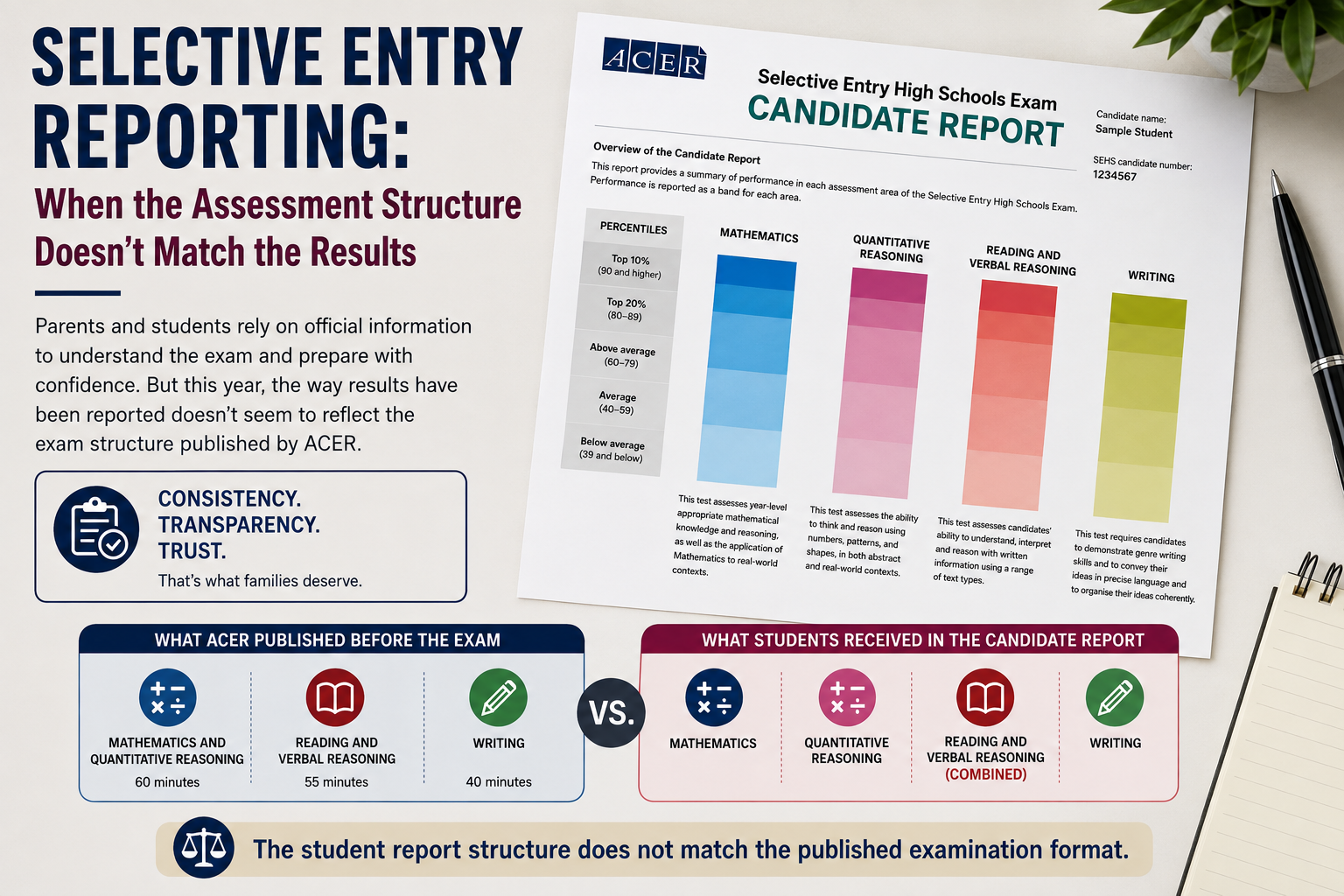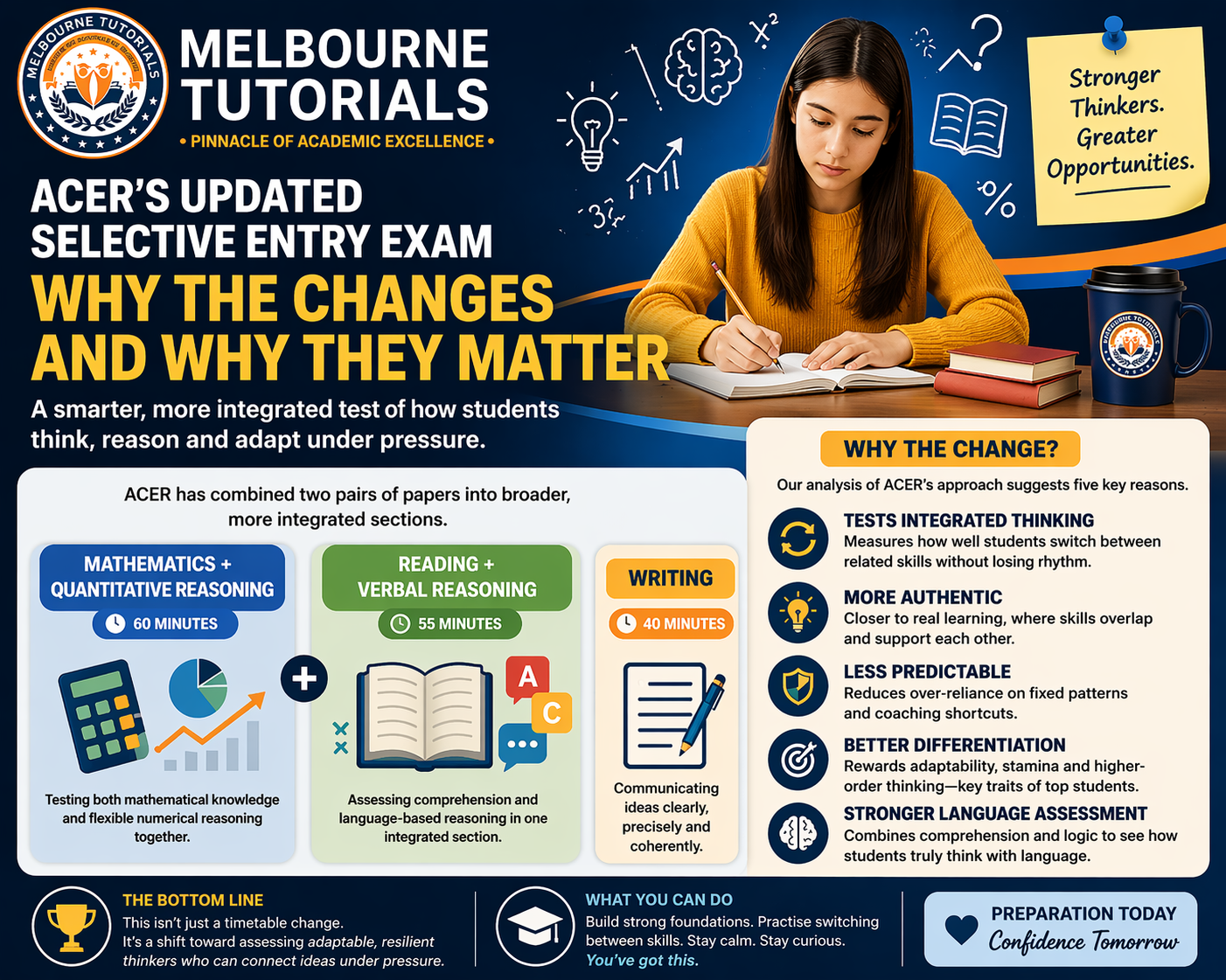
The Victorian Selective Entry High School examination, administered by ACER for Year 9 entry in 2027, now uses a revised structure. The exam is organised into three components: Mathematics and Quantitative Reasoning (60 minutes), Reading and Verbal Reasoning (55 minutes), and Writing (40 minutes). ACER states that the full exam process takes about four hours, including registration, exam time and breaks, while the exam tasks themselves take 2 hours and 35 minutes to complete.
This change has naturally led many parents and students to ask an important question: why would ACER combine sections that were previously treated separately? ACER’s public pages clearly describe the revised format and the skills assessed, but they do not appear to publish a direct statement saying, “These are the exact reasons we combined the papers.” What follows, therefore, is a reasoned interpretation based on ACER’s published exam structure, skill descriptions and broader assessment philosophy.
What ACER says about the current format
ACER describes Mathematics as assessing year-level mathematical knowledge and reasoning, including the application of Mathematics to real-world contexts. Quantitative Reasoning is described as the ability to think and reason using numbers, patterns and shapes in abstract and real-world contexts.
For the language section, ACER describes Reading as the ability to access and retrieve information and to integrate, interpret, reflect on and evaluate ideas communicated in texts. Verbal Reasoning is described as the ability to think and reason using words, concepts and logic.
So although the papers are now grouped into broader sections, ACER still treats the underlying skill areas as distinct. That is important because it suggests the change is not about removing those abilities but about assessing them in a more connected way. This is an inference from ACER’s structure and descriptions.
Why might ACER have combined Mathematics and Quantitative Reasoning?
One likely reason is that ACER may want to assess whether students can move smoothly between learnt mathematical methods and flexible numerical reasoning in one continuous sitting. In the old style of separate papers, students could mentally compartmentalise the tasks: first “maths mode,” then later “QA mode.” In a combined section, students may need to shift more fluidly between direct calculation, application, pattern recognition and logical reasoning under the same time pressure. This is our interpretation, but it fits ACER’s emphasis on reasoning, challenge and the application of skills.
Another possible reason is that the distinction between “school mathematics” and “reasoning with mathematics” may be too artificial when identifying high-ability students. A strong candidate is not only expected to know mathematical procedures, but also to think with numbers, identify relationships, recognise patterns and apply ideas in unfamiliar situations. Combining the two papers may therefore allow ACER to assess mathematical thinking more authentically. This is an interpretation rather than a stated ACER explanation.
A third likely reason is that a combined paper makes the test less predictable. Where papers are strictly separated, students can prepare in a very mechanical way and rely heavily on fixed expectations about sequence and mindset. By combining Mathematics and Quantitative Reasoning, ACER may be rewarding students who are conceptually strong, adaptable and calm when the style of questioning changes. That interpretation is consistent with ACER’s published emphasis on higher-order thinking, logical deduction, making connections and solving non-routine problems.
Why might ACER have combined Reading and Verbal Reasoning?
A similar idea may explain the language section. In real academic work, students do not simply “read first” and “reason verbally later.” Strong readers are constantly inferring, analysing, comparing, interpreting tone, recognising relationships between ideas and applying logic to language while they read. In that sense, Reading Comprehension and Verbal Reasoning are deeply interconnected. Combining them may allow ACER to assess whether a student can think through language in a more integrated and flexible way. This is our interpretation, grounded in ACER’s published descriptions of those skills.
There is also a strong overlap between the two abilities. A student who answers reading questions well often needs verbal reasoning skills to infer meaning, detect implied relationships, interpret vocabulary in context, and draw logical conclusions. Likewise, strong verbal reasoning depends heavily on a precise understanding of language. ACER’s broader verbal-and-critical-reasoning materials describe this domain as assessing the ability to interpret and understand ideas in language, which supports the view that ACER values integrated language thinking rather than isolated exercise types.
As with the maths section, combining Reading and Verbal Reasoning may also reduce over-reliance on rigid preparation habits. Students who expect a neatly separated “comprehension mode” and then a later “verbal logic mode” may find a combined paper more demanding. But students with strong reading habits, broad vocabulary, sound inferential thinking and composure under pressure may actually benefit. That conclusion is an inference from ACER’s structure and its broader emphasis on reasoning and challenge.
Our view: this is about integrated thinking
In our view, the most convincing explanation is that ACER is moving toward a format that rewards integrated reasoning rather than narrow, compartmentalised preparation. The revised structure appears designed to reveal not only what students know, but also how they think when they have to switch between related cognitive demands without a clean mental reset. This is not an official ACER statement, but it is a reasonable conclusion from the current format and from ACER’s broader published emphasis on reasoning, making connections, higher-order thinking, and solving unfamiliar problems.
In practical terms, this means the exam may now favour students who can:
- apply strong concepts across related question types
- shift gears quickly without losing confidence
- remain calm when the paper feels mixed or unfamiliar
- think clearly under time pressure
- respond flexibly rather than relying on predictable patterns
These are inferred implications of the revised structure, not a published ACER checklist. Still, they align closely with the kinds of reasoning abilities ACER highlights in its other assessment materials.
What this means for students and parents
The message for students is not to fear the change, but to prepare for it intelligently. Students should continue building strong foundations in Mathematics, Quantitative Reasoning, Reading and Verbal Reasoning as separate skill areas. At the same time, they should also practise moving between related styles of thinking within the same sitting. The goal is not merely to complete many questions, but to become more adaptable, more composed and more flexible in reasoning. This recommendation is our educational view based on the updated ACER structure.
For parents, the change is also a reminder that high-level preparation is not only about content coverage. It is about helping students develop confidence, resilience, exam temperament and the ability to handle surprises without panic. If ACER’s intention is indeed to identify students who can reason, interpret and adapt under pressure, then the students who will stand out are likely to be those who are genuinely prepared — not just those who are trained for predictable patterns. This is an interpretation, but one that fits ACER’s assessment philosophy.
Final thoughts
The combining of Mathematics with Quantitative Reasoning and Reading with Verbal Reasoning appears to be more than a timetable adjustment. It likely reflects a broader assessment direction: testing how well students can think across related domains in a connected, flexible and resilient way. ACER’s published exam structure supports that view, even if ACER has not publicly listed a precise rationale for the change.
At Melbourne Tutorials, we believe this change should be seen as an opportunity. Students who strengthen concepts, practise consistently, develop calmness under pressure and remain open to unfamiliar challenges are the ones most likely to benefit. In that sense, the revised format does not simply ask, “What does the student know?” It also asks, “How well can the student think when the boundaries between skill areas are no longer so neatly separated?” This final interpretation is ours, not ACER’s.