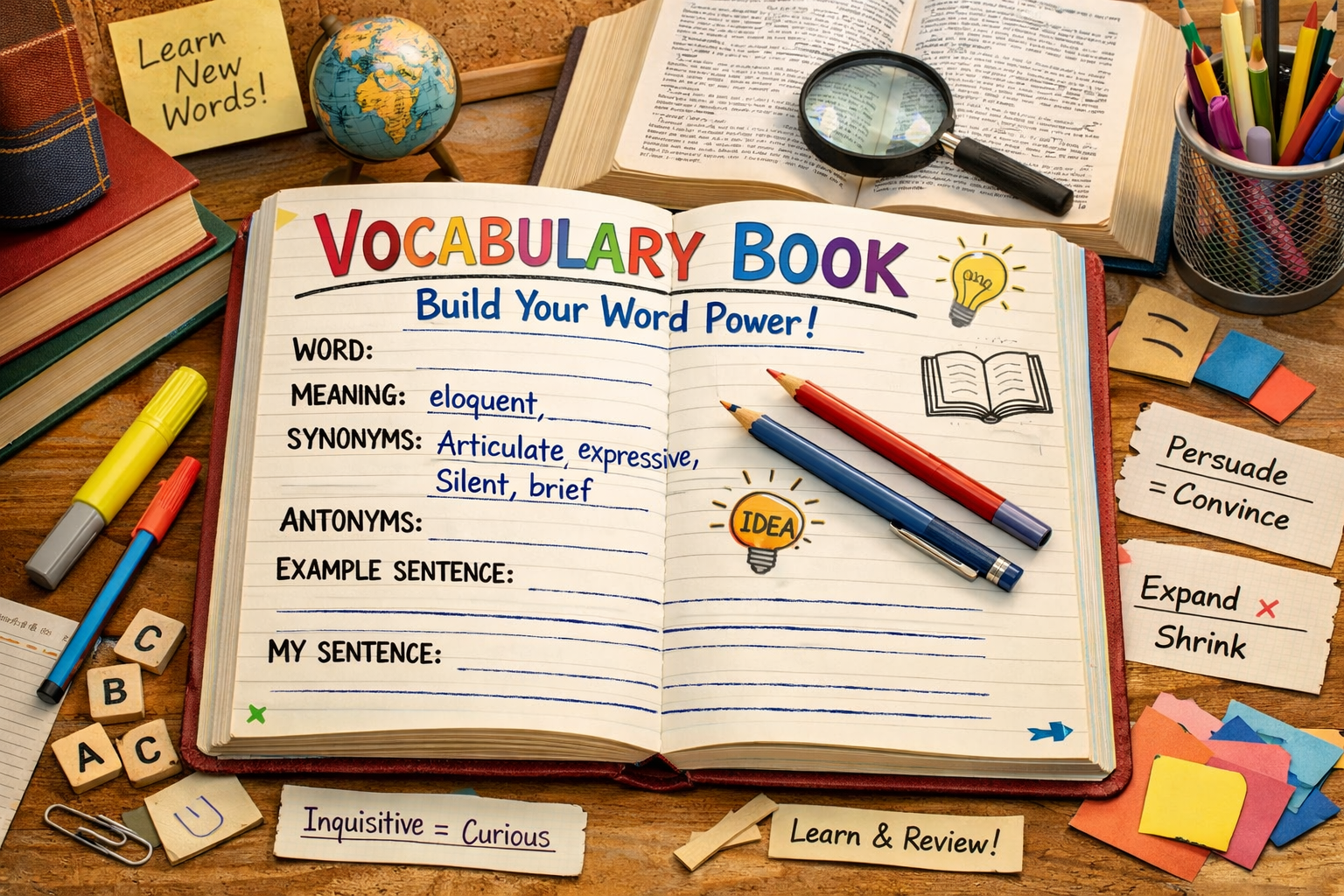
Selective Entry exams reward students who can understand language quickly, think clearly, and express ideas accurately. One of the simplest and most powerful habits a student can build is keeping a word book (vocabulary book). It becomes a personal dictionary of new words, meanings, synonyms, antonyms, and real examples — and over time, it turns into a vocabulary “bank” they can use in verbal reasoning, reading comprehension, and writing.
Why a Word Book Matters
1) Vocabulary is the backbone of verbal reasoning
Verbal reasoning questions often test:
-
word meanings
-
relationships between words
-
synonym and antonym patterns
-
shades of meaning (similar words with slightly different uses)
A word book trains students to notice words and remember them, which directly improves speed and accuracy.
2) Better vocabulary improves reading comprehension
When a student doesn’t know key words in a passage, they lose meaning, misinterpret the tone, or struggle to answer inference questions. As vocabulary increases:
-
Passages feel easier
-
Comprehension becomes faster
-
Students can focus on deeper thinking rather than decoding basic words
3) Writing becomes stronger and more mature
Students with a growing vocabulary:
-
avoid repeating simple words (“good”, “nice”, “sad”)
-
write more precise sentences
-
use stronger verbs and richer descriptions
-
improve persuasive and narrative writing quality
Vocabulary gives students more tools to express ideas clearly and impressively.
What Should Go Into a Selective Entry Vocabulary Book?
A good word book is not just a list of words. It should include meaning + usage + word relationships.
For each new word, students should record:
-
The word
-
Pronunciation (optional but helpful)
-
Part of speech (noun/verb/adjective/adverb)
-
Meaning in simple words
-
Synonyms (2–4 strong ones)
-
Antonyms (2–4 clear opposites)
-
One dictionary sentence (to see formal usage)
-
One student-made sentence (to prove understanding)
-
Word family (if relevant: decide, decision, decisive)
-
Common collocations (words it commonly pairs with, e.g., “make an effort”, “strongly oppose”)
This structure turns the book into an active-learning tool rather than a passive-copying one.
How Students Should Find New Words
Selective Entry students can build a powerful word list by collecting words from:
-
reading comprehension passages
-
novels and short stories (age-appropriate but challenging)
-
newspaper articles for kids/teens
-
school textbooks and class discussions
-
teacher word lists and mock tests
-
words they hear in speeches, debates, documentaries, or podcasts
The rule is simple: if a word is unfamiliar or used in an interesting way, it goes into the word book.
The Dictionary Step: The Most Important Part
Many students write down a word and its meaning once and forget it. The difference comes from properly exploring the word.
Students should be trained to use a dictionary to check:
-
the exact meaning (not just a vague idea)
-
example sentences
-
multiple meanings (if any)
-
whether it is formal/informal
-
how it is used in real contexts
This is how vocabulary becomes “usable” in exams and writing.
How to Organise the Word Book
A word book can be organised in several ways. The best option is the one the student will actually maintain.
Option A: Alphabetical (A–Z)
Good for quick revision and finding words easily.
Option B: Theme-based
Excellent for writing. Themes like:
-
emotions
-
character traits
-
persuasion and opinion
-
nature and setting
-
conflict and problem-solving
Option C: Weekly sets (recommended for Selective Entry)
For example:
-
Week 1: Words 1–20
-
Week 2: Words 21–40
This makes it easy to revise regularly and track progress.
Revision: Turning the Word Book Into Results
A vocabulary book only works when students revisit it. These are effective revision methods:
-
Quick daily review (5 minutes): read yesterday’s words aloud
-
Weekly test: synonyms/antonyms + sentence creation
-
Use-in-writing challenge: include 3–5 words in a paragraph
-
Mix and match: choose a synonym and rewrite a sentence using it
-
Mini verbal reasoning practice: identify odd-one-out, analogies, and word relationships using the word list
Revision transforms vocabulary from “known once” to “known forever”.
How Parents and Teachers Can Support This Habit
-
Encourage students to keep the book neat and consistent
-
Set a realistic target (e.g., 10–15 new words per week)
-
Ask the student to explain a new word at dinner in one sentence
-
Praise consistency, not just quantity
-
Make it part of the weekly homework cycle
The goal is a long-term habit, not a one-week burst.
Final Thought
A vocabulary book is one of the highest-return tools a Selective Entry student can build. It strengthens verbal reasoning, makes reading comprehension smoother, and lifts writing quality by giving students the words they need to think clearly and express ideas powerfully.
Over time, this simple notebook becomes a student’s personal advantage — word by word, week by week.