In competitive examinations such as the Victorian Selective Entry High School test (conducted by the Australian Council for Educational Research) and other academic competitions, one skill quietly determines outcomes more than any other:
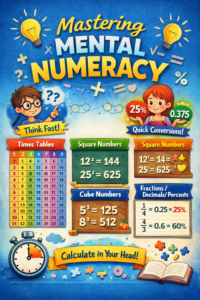
Mental numeracy.
While students and parents often focus on complex problem-solving strategies, advanced reasoning techniques, and difficult practice papers, a fundamental truth is often overlooked:
If basic calculations are not automatic, advanced thinking becomes slow.
And in competitive exams, slow means unfinished.
The Reality of Time Pressure
Consider a typical exam format:
- 50 questions
- 30 minutes
- Approximately 36 seconds per question
Within those 36 seconds, a student must:
- Read the question
- Understand the concept
- Plan a strategy
- Calculate
- Select the correct answer
If a student is still working out:
- 17 × 8 or 180 x 19 or 3000 x 150
- 0.0025 x 0.25
- 1600x 16000
- 14² or 0.29²
- 25% of 360
- 0.350 as a fraction
They are spending precious seconds on what should be instant recall.
Across 50 questions, even an extra 10–15 seconds per question can mean 8–10 unanswered questions at the end of the paper.
This is not a knowledge problem. It is an automaticity problem.
What Is Mental Numeracy?
Mental numeracy is the ability to perform mathematical operations quickly and accurately in one’s head, without extensive written working.
It includes:
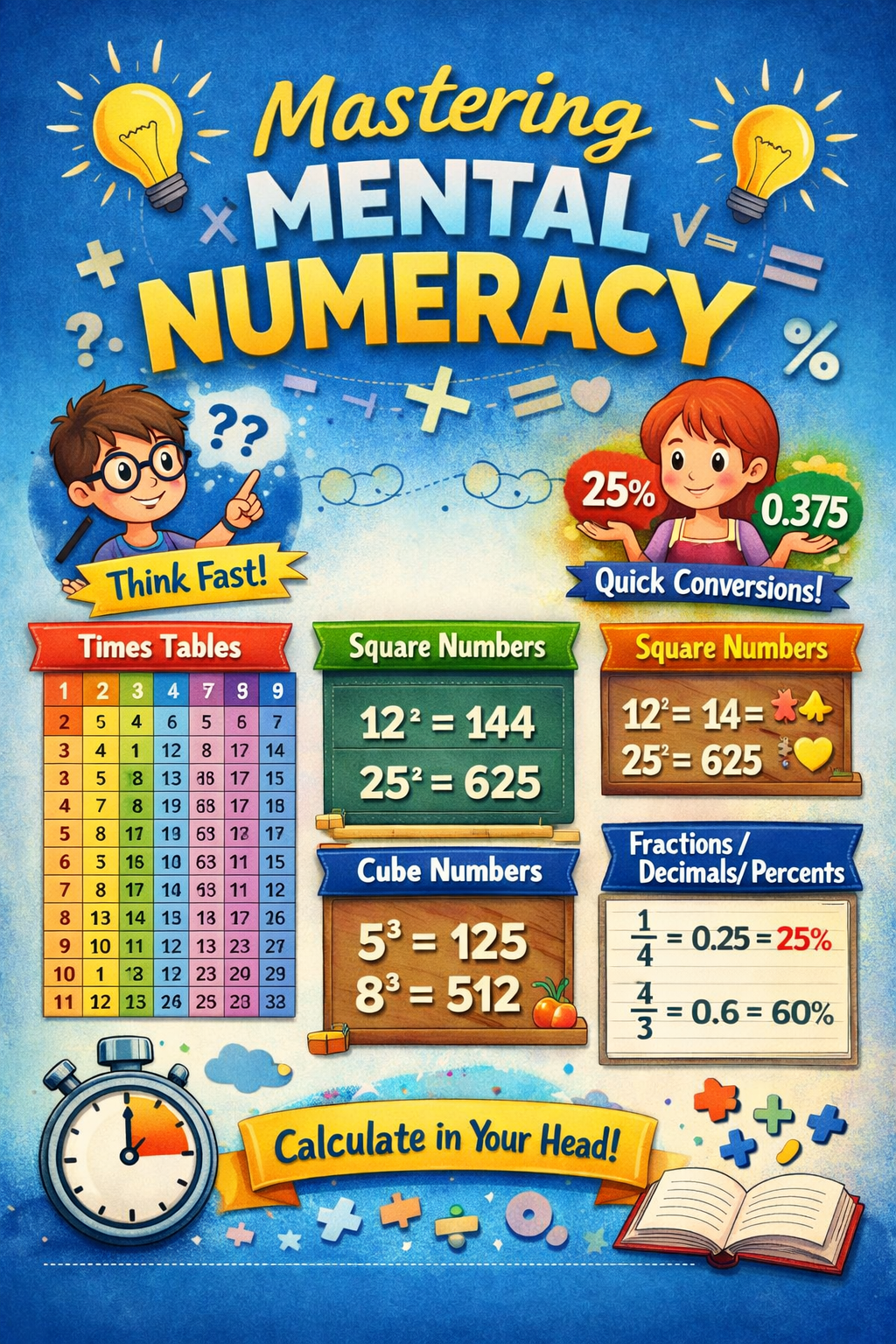
- Instant recall of times tables (up to 20)
- Instant recall of squares (up to 30)
- Instant recall of cubes (up to 10)
- Confident fraction–decimal–percentage conversion
- Quick simplification before multiplying
- Recognition of numerical patterns
- Estimation skills
These are not “advanced” skills.They are foundational.
The Hidden Gap We Commonly Observe
Many students in Years 7–9 preparing for Selective Entry:
- Do not know their tables beyond 12
- Hesitate when recalling squares
- Struggle with simple percentage conversions
- Expand numbers instead of simplifying
- Write extensive working for basic arithmetic
This results in:
- Cognitive overload
- Increased anxiety
- Slower reading speed
- Fatigue mid-paper
- Avoidable mistakes
A student who spends mental energy calculating 16 × 7 cannot simultaneously focus on higher-order reasoning.
Why Automatic Recall Matters
The brain has limited working memory.
When foundational facts are automated, the brain is free to:
- Analyse multi-step reasoning
- Detect shortcuts
- Identify traps
- Eliminate distractor options
In competitive exams, speed is not about rushing.
It is about efficiency. And efficiency begins with memory.
The Non-Negotiable Memory Bank
For competitive success, the following must be automatic:
Times Tables (1–20)
Squares (1–30)
Cubes (1–10)
Useful in pattern questions and especially useful in higher reasoning and number theory questions.
Fraction–Decimal–Percentage Conversions
Students should instantly recognise:
- 1/2 = 0.5 = 50%
- 1/4 = 0.25 = 25%
- 3/4 = 0.75 = 75%
- 1/8 = 0.125 = 12.5%
- 0.2 = 1/5 = 20%
Without written conversion.
Extensive Working vs Strategic Thinking
In competitive exams, excessive working is often a sign of weak mental numeracy.
Strong students:
- Simplify before multiplying
- Cancel fractions early
- Use estimation to eliminate options
- Recognise patterns immediately
Weak automatic recall leads to:
- Full expansion
- Long division
- Multi-line arithmetic
- Time exhaustion
Mental Numeracy Is Not a Crash Skill
It cannot be developed in two weeks.
It requires:
- Daily short drills
- Timed practice
- Recall testing
- Consistency
Mental speed develops gradually through repetition, not through complex worksheets.
The Bigger Picture
Selective Entry exams test more than intelligence.
They test:
- Processing speed
- Accuracy under time pressure
- Cognitive efficiency
- Mathematical maturity
Students who master foundational numeracy early:
- Feel calmer in exams
- Finish papers confidently
- Make fewer careless mistakes
- Have mental space for advanced reasoning
Final Thought
Advanced reasoning impresses. But automatic basics win.
Before attempting the hardest problems, students must first ensure that multiplication, squares, cubes, and numerical conversions are effortless.
Because in a 30-minute paper, every second counts.
And mental numeracy is the difference between thinking and calculating.