Selective Entry School Reforms in Victoria: When Equity Becomes Inequity
Victoria’s Selective Entry High Schools have long represented excellence in education—providing a pathway for academically gifted students to reach their full potential. However, recent changes to the selection process have sparked concern among educators, parents, and students alike. While each change claims to enhance fairness and inclusion, there’s growing unease that these measures are instead eroding the core values of merit and transparency.
Change in Test Authority: From Edutest to ACER
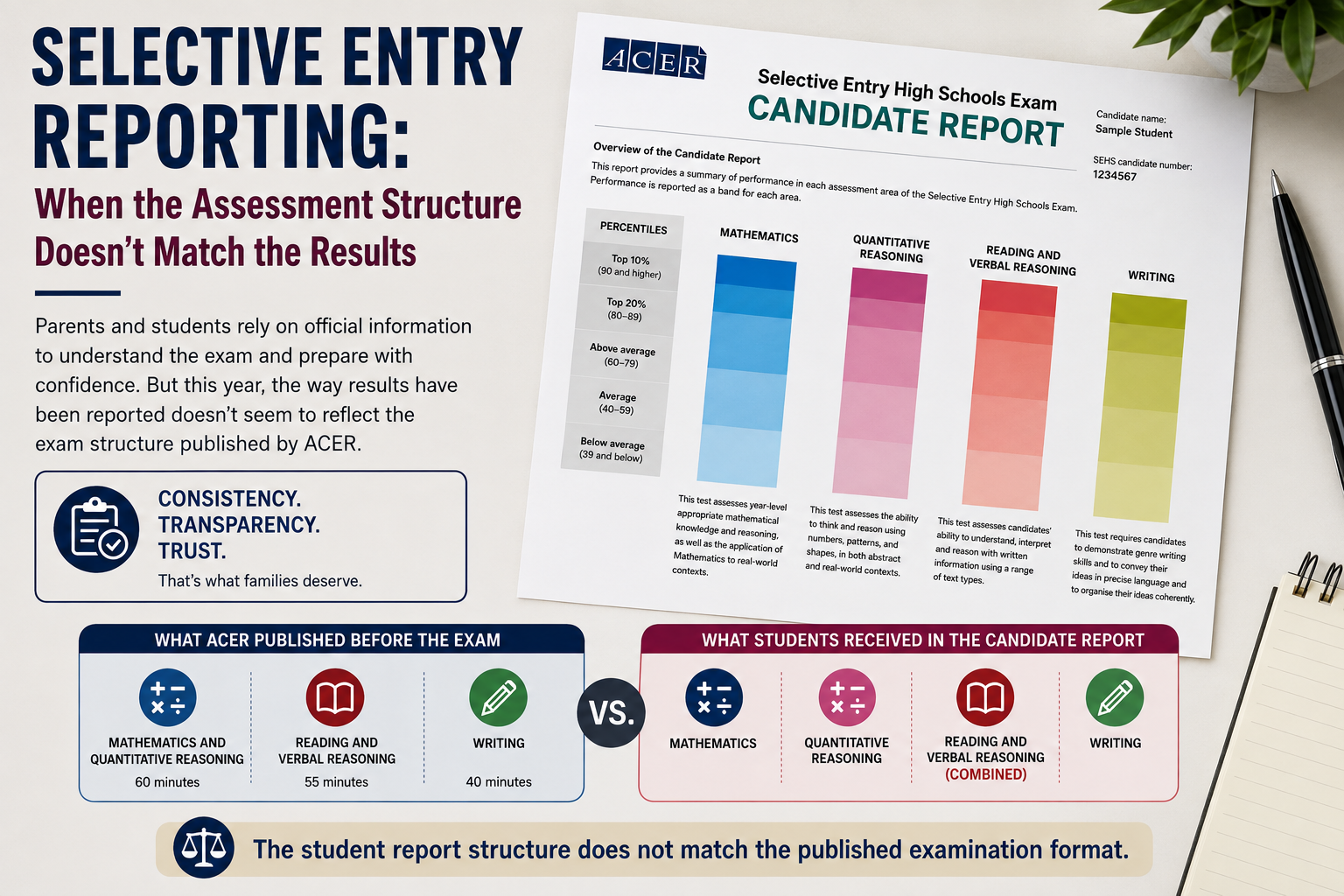
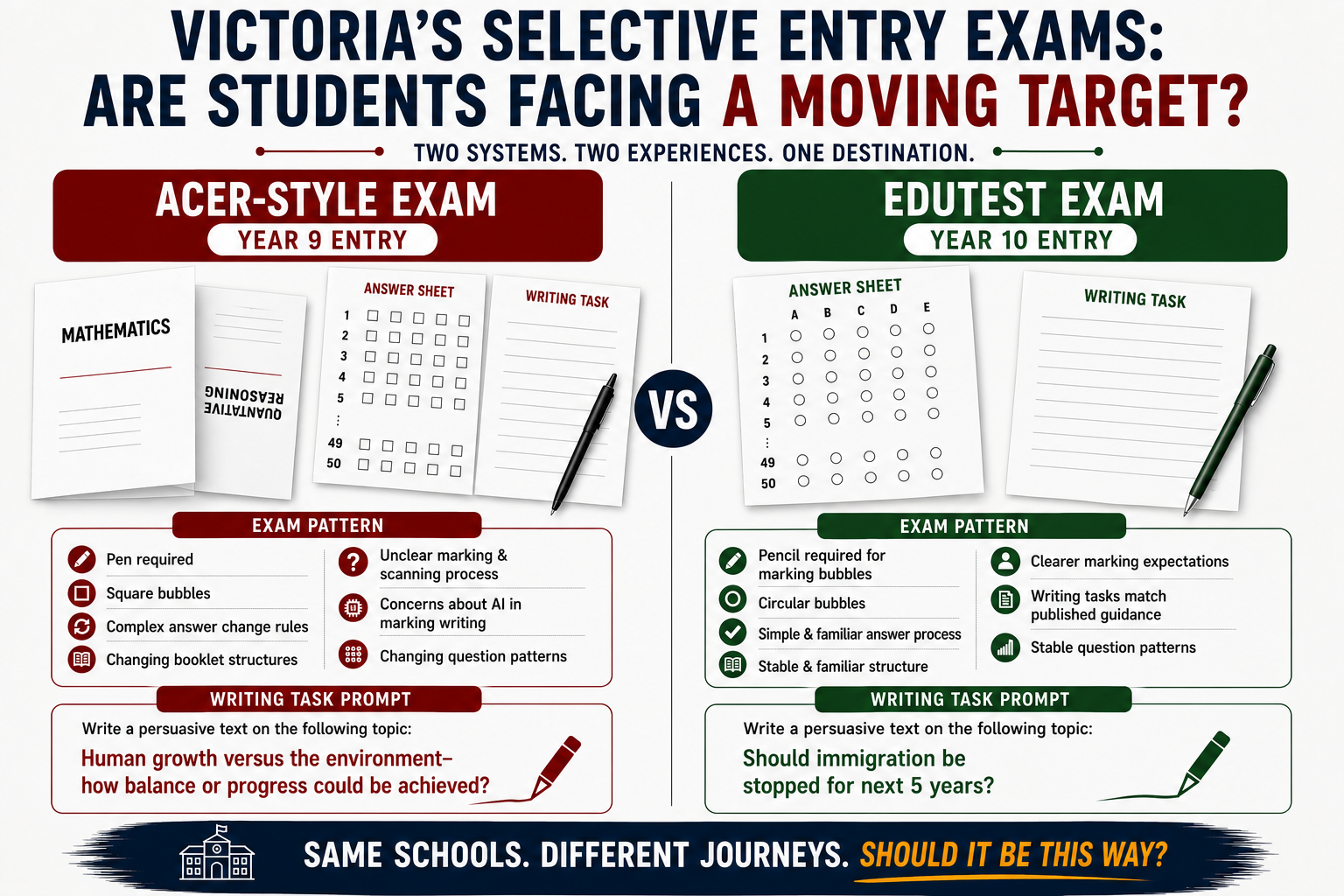
The first major transformation came with the switch from Edutest to ACER as the official testing provider. This shift brought a dramatic change in testing style—placing greater emphasis on abstract reasoning and complex comprehension. Many students struggled to adjust, especially those without access to advanced coaching or practice materials. With little transitional support, the sudden shift left many high-performing students at a disadvantage, simply due to unfamiliarity with the new format.
Unstable Writing Requirements: Two Tasks, Then One, Then Two Again
Another confusing change was the fluctuation in the writing component of the exam. For several years, students were expected to complete two pieces of writing—a persuasive and a narrative text. Then, without much notice or explanation, the format was changed to include only one writing task, leaving students and educators scrambling to adjust their preparation strategies.
Now, the requirement has reverted back to two writing tasks, reinstating the original format. These back-and-forth changes reflect a lack of consistency in testing standards, creating uncertainty and anxiety for students who are already preparing for a highly competitive exam. It also disadvantages students who rely on structured preparation, often through schools or tutors, to develop specific writing skills.
The New Quota System: From a 3% Cap to Tiered Allocation
Historically, the selection process imposed a 3% cap per school, ensuring that no more than 3% of students from any one school could gain admission to selective entry schools. This was designed to maintain diversity and prevent high-performing schools from dominating the intake.
This was then revised to a flat 5% cap across all schools, seemingly simplifying the system—but in 2024, the Department introduced a more complex tiered quota system based on school type:
-
12% quota for P–9 schools
-
5% quota for all other schools
In 2025, this was revised again to:
-
10% for P–9 schools
-
4% for all other schools
This ongoing shift reflects a move towards favouring students from smaller or non-traditional secondary schools—likely in an effort to address educational disadvantage. However, it has led to unintended consequences. Students with lower overall scores from P–9 schools are sometimes offered places over students from academically competitive P–12 or secondary schools who scored significantly higher.
While well-meaning in its attempt to broaden access, this approach raises serious questions about fairness and meritocracy. Should students be selected based on the type of school they attend, rather than their demonstrated academic ability?
By dividing quotas this way, the system arguably disadvantages students who attend high-performing schools and encourages families to consider strategic school placements—not for better education, but for statistical advantage.
Gender Balancing in Co-Ed Schools: A Regressive Step?
Most recently, it has come to light that gender balance is now also a factor in the final selection process. Though not formally disclosed in detail, the ACER website suggests that selective schools are now actively seeking to balance the ratio of male and female students.
While gender parity is important in education, applying it as a final filter in a merit-based selection process—without transparency or public consultation—raises significant ethical questions.
If a male student scores higher but is passed over in favour of a female student due to gender balancing, is that fair? Conversely, is it fair to female students if places are reserved for male applicants to meet an internal ratio? In the absence of clarity or open criteria, both genders are left questioning the legitimacy of their selection—or rejection.
This change is especially problematic given that Victoria already has two gender-specific selective schools:
-
Melbourne High School (boys)
-
Mac.Robertson Girls’ High School (girls)
In addition to these, two comparatively newer co-educational schools—Nossal High School and Suzanne Cory High School—were intended to provide equal opportunity to all high-achieving students regardless of gender.
By now applying gender-balancing measures in these co-educational schools, the system is not only undermining the principle of meritocracy but also creating unnecessary and unfair barriers. This move strikes at the root of fairness and is, in many ways, regressive—especially when high-performing students are excluded on the basis of gender.
Are We Compromising Excellence?
While striving for diversity and equity is admirable, it cannot come at the cost of transparency and excellence. The current trajectory of reforms—from shifting test formats and altering quotas to silent gender filters and unstable writing requirements—suggests a system increasingly shaped by social engineering rather than objective academic achievement.
If the aim is to support underrepresented or disadvantaged students, the focus should be on early educational support, access to quality teaching, and resources, rather than adjusting the outcome of a competitive selection process.
Conclusion
Victoria’s selective schools were built on the foundation of academic excellence. With each silent or opaque change—especially those that devalue merit—the system risks losing credibility and student trust. Equity and excellence are not mutually exclusive, but equity must begin with opportunity, not outcome manipulation.
It’s time to ask: are we truly supporting students through fairness, or are we creating a new form of unfairness disguised as reform?