Victoria’s Selective Entry Exams: Are Students Facing a Moving Target?
Victoria’s selective entry school system has long been seen as a pathway for academically capable students to access challenging and enriching educational opportunities. For many families, the selective entry exam represents a serious and high-stakes process, requiring months or even years of preparation.
However, recent student debriefs from the Year 8 ACER-style Selective Entry Exam( for Year 9 entry) and the Year 9 Edutest-style exam (for Year 10 entry) have raised important questions about consistency, transparency, and fairness.
This article is based on student debriefs and parent observations following the recent selective entry exams. It is intended to raise questions about the testing process from an educator and parent perspective, rather than make claims about official marking practices that have not been publicly confirmed.
A Tale of Two Testing Systems
Students preparing for selective entry appear to be facing two quite different testing systems, even though both pathways lead to the same selective entry school environment.
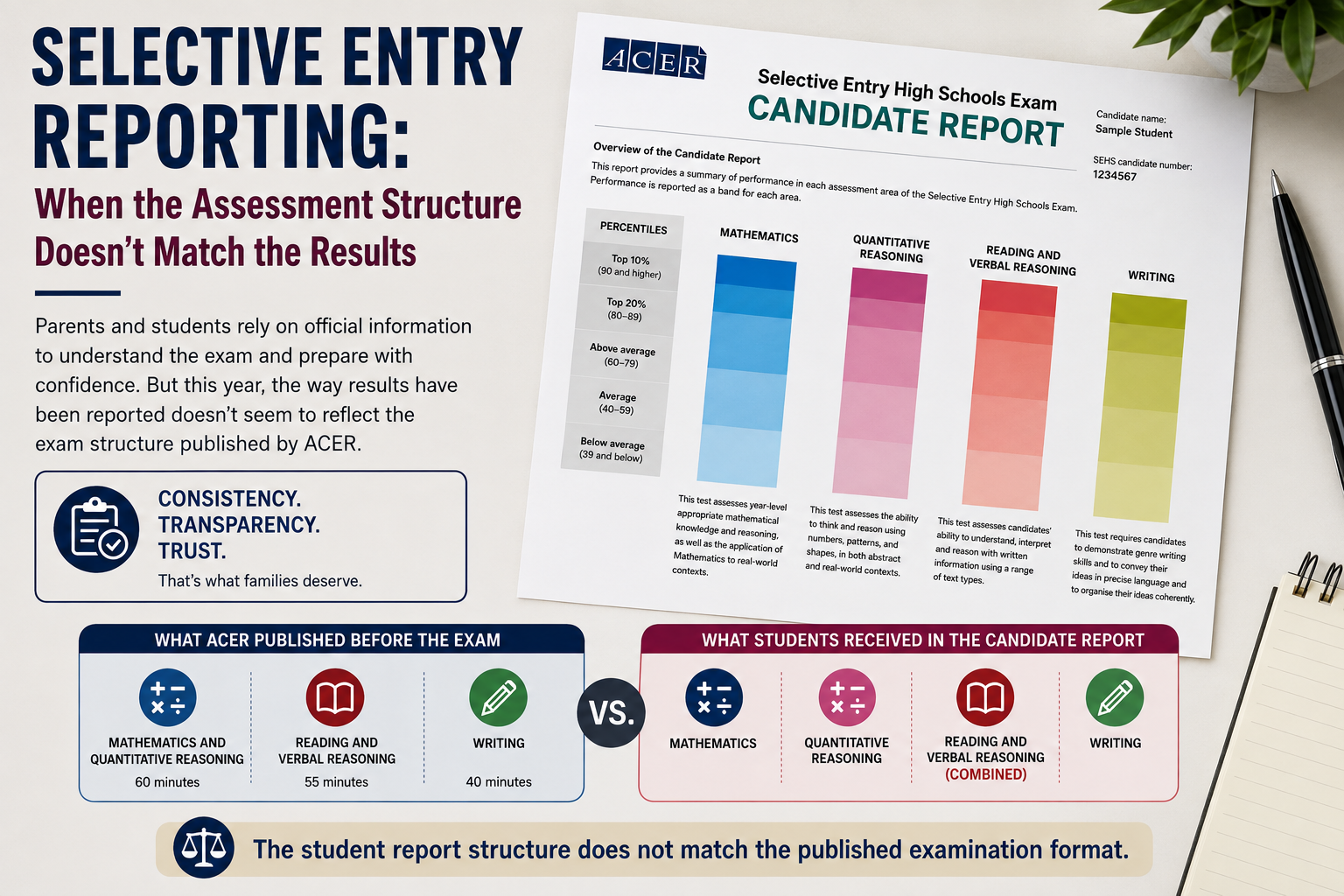
Year 8 students who sat the ACER-style selective entry exam reported a test structure that differed from previous years in several ways. One of the most significant changes was in the way Mathematics and Quantitative Reasoning were presented. These two sections were combined into one booklet, with 75 questions to be completed in 60 minutes.
Students reported that Mathematics and Quantitative Reasoning were printed on reverse sides of the same booklet. After the stipulated time for Mathematics, students had to turn the booklet over and begin the Quantitative Reasoning section from the reverse side.
In a high-pressure exam, even small procedural changes can create unnecessary confusion. Students are already managing time pressure, accuracy, problem-solving, and exam anxiety. Adding unusual booklet-handling instructions may distract students from the actual academic task.
In contrast, Year 9 students who sat the Edutest-style exam for Year 10 entry reported a more conventional and predictable format. The exam appeared to follow a pattern that Edutest has maintained over the years, giving students greater clarity about what to expect.
ACER’s Less Predictable Exam Style
One of the major concerns raised about the ACER-style selective entry exam is its apparent lack of uniformity from year to year. Over recent years, students have experienced changes not only in the testing provider but also in the exam format, timing, writing requirements, answer sheet design, and response correction rules.
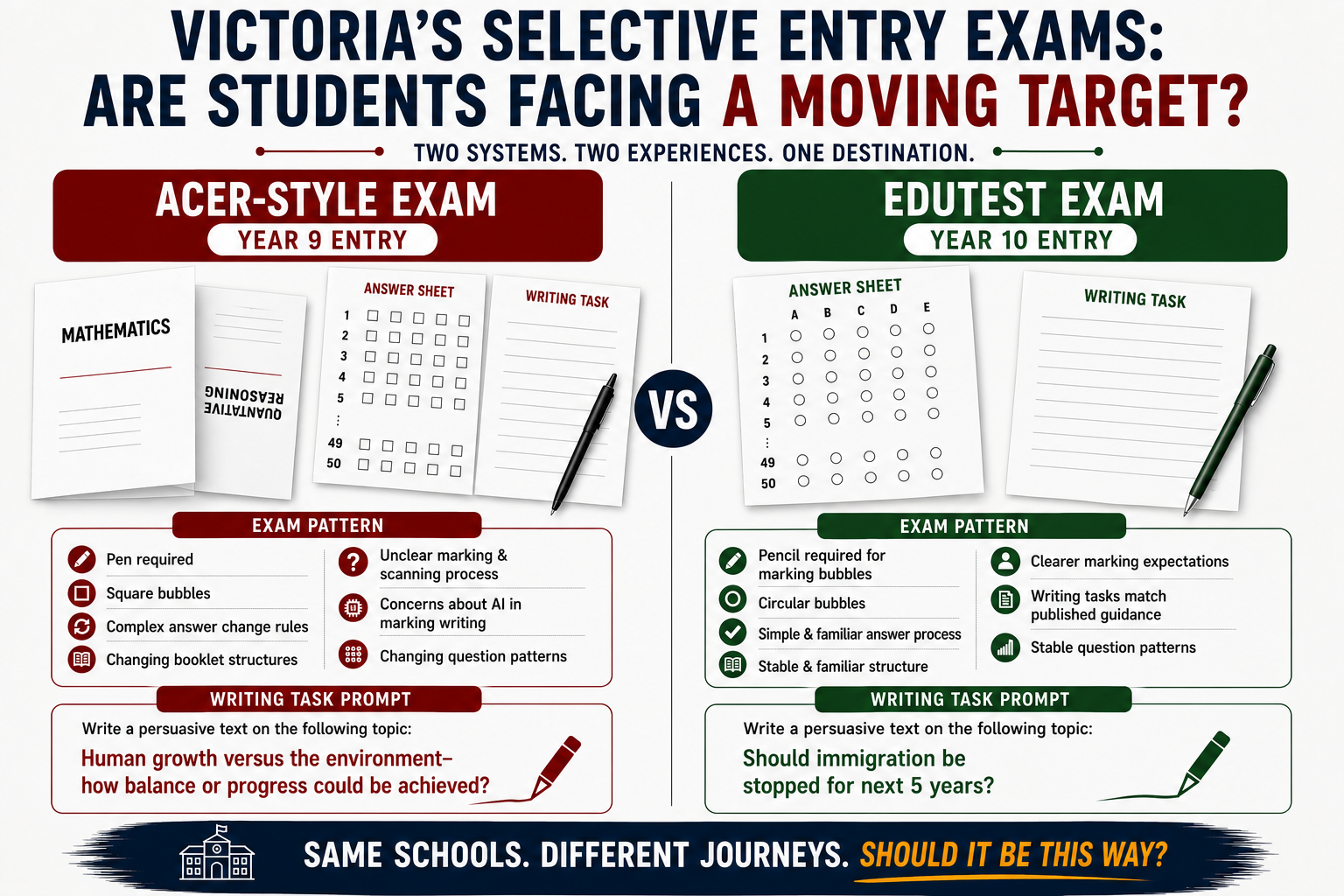
For example, students were reportedly required to use pen and follow a specific method if they wanted to change their answers. If a student wished to change a response, they had to cross out their original choice and select a new one. If they later wanted to return to their original answer, they had to cross out the newer response and circle the earlier one.
This is an unusual system for a multiple-choice exam, particularly for Year 8 students working under time pressure. Instead of simply testing reasoning and academic ability, the process may also test how well students can remember and apply procedural instructions in a stressful environment.
Students also reported that the answer sheets used square bubbles, as was the case last year. This differs from the more traditional circular bubbles used in the Edutest-style exam. While this may seem like a minor difference, small changes in exam mechanics can affect young students’ confidence, speed, and certainty during a highly competitive exam.
Unclear Scanning and Marking Procedures
Another concern relates to how changed multiple-choice responses are interpreted during marking. In many multiple-choice exams, answer sheets are scanned and read electronically. If one answer is crossed out, another is selected, and then the second answer is crossed out while the earlier answer is circled, how does the marking system accurately identify the student’s final intended response?
This is especially concerning for young students working under significant time pressure. Cross-outs, circles, pen marks, uneven shading, or accidental marks could potentially create ambiguity. Unless the Department or testing authority clearly explains whether such responses are read by a scanner, manually checked, or verified through a secondary review process, parents and students are left uncertain about whether every answer is being interpreted fairly.
In a high-stakes selection exam, even one incorrectly read answer can affect a student’s final ranking. Therefore, any answer-changing procedure should be simple, standardised, and clearly compatible with the marking system. If pen-based corrections are being allowed, there should be transparent reassurance about how these corrections are identified and reviewed.
Concerns were also raised about the writing papers, where square boxes were reportedly used. This has led some parents to wonder whether writing responses may be scanned or assessed using automated systems. There is no confirmed evidence that AI is being used to mark writing responses. However, the concern itself reflects a broader lack of transparency.
If writing tasks are being marked by human assessors, this should be clearly stated. If any form of automated marking, digital scanning, or AI-assisted assessment is being used, parents and students deserve to know. Writing is a complex skill involving structure, originality, reasoning, expression, tone, vocabulary, and creativity. Reducing such a task to automated evaluation without clear disclosure and moderation would raise serious questions about fairness.
The issue is not simply whether technology is being used. Technology can support assessment when it is transparent, reliable, and carefully moderated. The real concern is the lack of clarity. In a selective entry exam, families should not have to guess how their child’s answers and writing are being assessed.
A fair system must provide confidence not only in the difficulty of the exam, but also in the accuracy and integrity of the marking process.
Verbal Reasoning and Reading Comprehension: Another Structural Difference
Another notable feature of this year’s ACER-style exam was the structure of Verbal Reasoning and Reading Comprehension. Students reported that these were placed in separate booklets, with a combined time of 55 minutes.
This is another example of how the exam format appears to shift. When timing, booklet structure, and section arrangements change from year to year, it becomes difficult for students and educators to prepare with confidence.
Selective entry exams are already demanding. Students must manage time pressure, accuracy, comprehension, reasoning, and written expression. Constant changes to exam structure add another layer of uncertainty that may disadvantage even capable and hardworking students.
Writing Task: Not Quite a Traditional Persuasive Essay
The writing component also appeared to move away from a straightforward persuasive format. Students reported that the stimulus was based around the idea of human growth versus the environment. Rather than simply asking students to argue for one side, the task appeared to ask students to take a particular line of thought and explain how balance or progress could be achieved.
This makes the task more nuanced, but also less predictable. It is not strictly a persuasive essay in the traditional sense. For students who prepared for a clear persuasive or narrative structure, this could have created confusion.
The issue is not that students should only be given predictable tasks. Strong students should be able to think flexibly. However, when the nature of the writing expectation is not clearly communicated, students are left guessing what kind of response is required.
By contrast, students who sat the Edutest-style Year 9 exam reported that the writing task aligned more closely with the style and expectations described on the selective entry website. This gave them a clearer framework and reduced unnecessary uncertainty.
Content Differences: Common Sense Versus Conceptual Testing
Students who sat the ACER-style exam also reported that the Mathematics section had very few formula-based questions. Many questions appeared to rely more on common sense, interpretation, and reasoning rather than developed mathematical concepts.
Similarly, the vocabulary in Verbal Reasoning was reportedly not as challenging as in earlier exam styles. Students felt that the questions were less about advanced vocabulary and more about general reasoning and everyday logic.
There is nothing wrong with testing reasoning skills. In fact, selective entry exams should assess a student’s ability to think critically and apply knowledge. However, when the exam moves too far away from established academic concepts, it becomes unclear what exactly is being measured: academic preparation, reasoning agility, adaptability to unfamiliar formats, or familiarity with ACER’s changing style.
Edutest: A More Conventional and Stable Model
In contrast, the Year 9 Edutest-style exam for Year 10 entry appeared to follow a more stable and traditional testing model.
Students used pencil, as is common in multiple-choice testing. The answer bubbles were circular. The exam focused more clearly on concepts tested under time constraints. Students were asked to do their working out on the reverse side of the answer sheet, as has been the practice in previous years.
The writing task also reflected the style and expectations described on the selective entry website. This gave students a clearer framework and reduced unnecessary uncertainty.
This suggests that Edutest is continuing to follow a more conventional model of selective testing, while the ACER-style exam appears, from student reports, to be following a less predictable approach.
The Problem for Students: One Destination, Two Systems
The most concerning issue is that many students who sit the Year 8 selective entry exam may later sit the Year 9 entry exam as well. This means the same students may encounter two very different testing systems while applying for entry into the same selective school environment.
One system reportedly uses pen, square bubbles, changing response rules, shifting booklet structures, and less predictable writing prompts. The other uses pencil, circular bubbles, a familiar format, concept-based testing, and clearer writing expectations.
This inconsistency creates confusion and may undermine confidence in the process. Students are not simply preparing for academic challenge; they are preparing for uncertainty.
A selective entry system should not feel like a moving target.
Why Consistency Matters in High-Stakes Testing
In any high-stakes exam, consistency is essential. Students and families invest significant time, effort, and resources into preparation. Teachers and tutors design structured programs to build the required skills. Schools rely on the exam as a measure of academic readiness.
When the testing format changes frequently, students are not competing on equal terms. Those who happen to adapt quickly to a new format may benefit, while equally capable students may be disadvantaged simply because they prepared for a different structure.
Transparency does not mean revealing exam questions in advance. It means providing clear, stable information about format, timing, answer procedures, writing expectations, marking procedures, and skill areas being assessed.
Without that clarity, the exam risks becoming less a test of academic ability and more a test of adaptability to administrative changes.
Are We Testing Ability or Confusion Management?
The purpose of a selective entry exam should be to identify students with strong academic potential. However, when students must navigate changing booklet formats, unusual answer correction rules, shifting writing styles, different response-sheet designs, and unclear marking processes, the exam may begin to test something else entirely.
- It may test how well students cope with uncertainty.
- It may test how quickly they can adjust to unfamiliar instructions.
- It may test their exposure to a particular exam style rather than their true academic depth.
- It may test whether students can follow unusual administrative procedures rather than demonstrate academic excellence.
This is particularly concerning for Year 8 students, who are still developing confidence in exam environments. A fair test should challenge their thinking, not confuse them with changing procedures.
The Need for Transparency and Standardisation
If Victoria’s selective entry schools are to maintain public confidence, the selection process must be transparent, stable, and consistent.
There should be clear communication about:
- The number of sections in the exam
- The timing for each section
- Whether students must use pen or pencil
- How students should change answers
- How changed answers are scanned or manually reviewed
- Whether writing responses are marked by humans, automated systems, AI, or a combination
- The style of answer sheet used
- The expected writing genres
- The balance between reasoning and curriculum-based concepts
These are not minor details. They directly affect how students prepare and perform.
If different testing providers are being used for different entry levels, the Department should explain why the systems differ so significantly. If the goal is to identify academic excellence, the testing process should reflect fairness, clarity, and consistency across all pathways.
Conclusion: Selective Entry Needs Stability, Not Experimentation
Victoria’s selective entry schools are highly respected institutions. They attract students who are motivated, capable, and ready for academic challenge. However, the testing process used to select these students must be worthy of that reputation.
Recent debriefs from Year 8 and Year 9 students reveal a clear divide. The ACER-style exam appears to be fluctuating in format and expectations, while the Edutest-style exam appears more conventional and predictable.
This inconsistency is unfair to students who are trying to prepare seriously and responsibly. A selective entry exam should be difficult, but it should not be unstable. It should challenge students academically, not confuse them procedurally.
If Victoria is committed to fairness and excellence, then the selective entry testing system must be transparent, consistent, and standardised. Students deserve to know the rules of the game before they step into the exam room, and they also deserve to know how their work will be read, marked, and interpreted after the exam.
Otherwise, we must ask: are we selecting the most academically capable students, or simply those who can best survive a constantly changing system?