Selective Entry Exam 2026: Reporting of Results
In a previous article, we discussed the numerous changes that have reshaped Victoria’s Selective Entry High School examination in recent years. Since ACER replaced Edutest as the testing authority, parents and students have witnessed a series of significant changes, including alterations to the examination format, writing requirements, school quota allocations and, most recently, the introduction of gender balancing in the selection process. While each individual change may have been introduced with good intentions, the cumulative effect has been a growing sense of inconsistency and uncertainty surrounding what was once regarded as a stable and transparent merit-based examination.
This year, another inconsistency has emerged—this time concerning the way student results have been reported. The issue is not about the difficulty of the examination itself, but about the apparent inconsistency between the assessment structure published by ACER before the examination and the assessment categories ultimately used in the Candidate Report. For parents and students who rely on official information when preparing for one of Victoria’s most competitive examinations, consistency and transparency are not optional—they are fundamental.
What ACER Told Parents
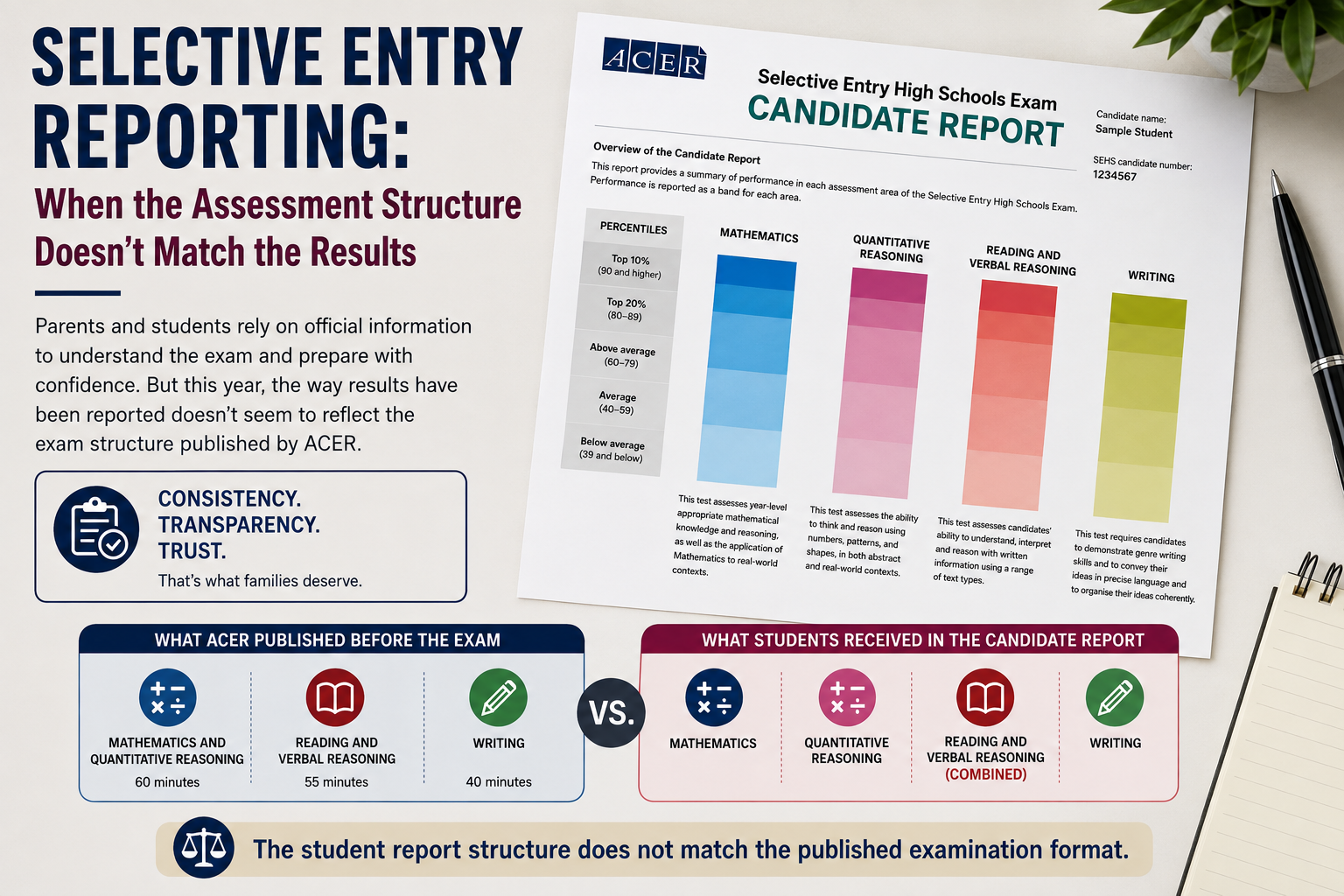
Before applications closed, ACER published the examination format on its official website.
The examination was presented as consisting of three assessment components:
- Mathematics and Quantitative Reasoning (60 minutes)
- Reading and Verbal Reasoning (55 minutes)
- Writing (40 minutes)
The examination itself reflected this structure.
Students completed:
- a Mathematics and Quantitative Reasoning session,
- a Reading and Verbal Reasoning session,
- followed by Writing.
Although Mathematics and Quantitative Reasoning were separate timed sections within the same booklet, they formed one examination component. Likewise, Reading and Verbal Reasoning were administered together within a single examination session.
Naturally, parents assumed the reporting of results would reflect this published structure.
The Logical Expectations
Given the examination format, there were two logical ways in which results could have been reported.
Option 1: Report each discipline separately:
- Mathematics
- Quantitative Reasoning
- Reading
- Verbal Reasoning
- Writing
This would provide detailed feedback across all five disciplines.
Option 2: Report the results exactly as the examination was structured:
- Mathematics and Quantitative Reasoning
- Reading and Verbal Reasoning
- Writing
This would mirror both the published examination format and the way students actually sat the examination.
Either approach would have been internally consistent.
What Actually Happened
Instead, the Candidate Report adopted a hybrid approach.
Students received separate results for:
- Mathematics
- Quantitative Reasoning
while receiving a combined score for:
- Reading and Verbal Reasoning.
Consequently, the report contained four assessment areas:
- Mathematics
- Quantitative Reasoning
- Reading and Verbal Reasoning
- Writing
This reporting structure does not appear to correspond with either the published examination format or a fully separate reporting model.
An Important Question of Consistency
This inconsistency naturally gives rise to several questions.
If Mathematics and Quantitative Reasoning were considered sufficiently distinct to justify separate reporting, why were Reading and Verbal Reasoning combined into a single assessment?
Conversely, if Reading and Verbal Reasoning were appropriately combined because they formed one examination component, why were Mathematics and Quantitative Reasoning not reported in the same way?
Parents are not questioning ACER’s expertise in designing assessments. Rather, they are seeking consistency between:
- the examination format published before applications,
- the way the examination was administered, and
- the way results were ultimately reported.
Why This Matters
Some may dismiss this as merely a reporting issue. It is not.
Students and parents rely on the published assessment framework when preparing for one of Victoria’s most competitive examinations. Schools, teachers and tutoring organisations also use this information to guide preparation and explain the assessment to families.
When the final reporting framework differs from the structure that applicants were led to expect, it creates unnecessary confusion.
Equally importantly, separate reporting of one pair of disciplines—but not another—can influence how parents interpret a student’s strengths and weaknesses. Without a clear explanation of why one component has been divided while another has been merged, the educational value of the report becomes less clear.
Transparency Builds Confidence
No examination system is perfect, and assessment models naturally evolve over time. However, any changes to how results are classified and reported should be clearly explained before students sit the examination.
Transparency is essential for maintaining confidence in a high-stakes, merit-based selection process.
Parents are entitled to understand not only what their children are being assessed on, but also how those assessments will ultimately be reported.
A simple explanation from ACER regarding the rationale behind this reporting structure would go a long way towards addressing the legitimate questions now being asked by many families across Victoria.