
What the summer break is actually for.
Director’s Message

Welcome to the first issue of our newsletter in some time. We are bringing it back because this year has raised more questions from parents than any year I can remember, and a monthly letter is a better place to answer them than a conversation at the front desk at six o’clock on a Tuesday.
Two things changed this year, and both are worth understanding before your child sits anything in 2027. The Victorian selective entry examination now runs as three components rather than five separate sections: Mathematics and Quantitative Reasoning together in sixty minutes, Reading and Verbal Reasoning together in fifty five, and Writing in forty. Then, after applications had already closed, the candidate report came back using four reporting areas rather than the three that were published. I wrote about that in August, and I will say the same thing here: the issue is not the difficulty of the examination. It is that families were asked to prepare for one structure and were reported against another.
What this means for your household over the next ten weeks is simpler than it sounds. The examination now rewards students who can move between related kinds of reasoning inside one sitting, rather than students who have drilled five separate paper types. That is not something you cram. It is built slowly, which is exactly what a summer break is good for.
So our ask this month is small and specific. Pick the two things in this issue that apply to your child, the numeracy drill in section three or the vocabulary book in section seven, and do fifteen minutes of one of them a day through the holidays. Not two hours on a Sunday. Fifteen minutes, most days. That is the difference we see in February.
Student Achievement Spotlight

Suhaas sat the 2026 Victorian Selective Entry Examination and earned a place at Melbourne High School. His cohort was the first to sit the restructured paper, three components rather than five separate sections, with Mathematics and Quantitative Reasoning combined into one sixty minute block and Reading and Verbal Reasoning into another of fifty five. Nobody who sat it in 2026 had a past paper in the new shape to practise on.
Suhaas prepared with us at our Truganina campus. Asked what made the difference, his teachers did not point to anything dramatic. He was diligent, he was punctual, and he took part in class rather than sitting through it.
Those three things, repeated every week over a long stretch, are what a selective entry result is actually made of. Ability gets a student into the room. Showing up and doing the work is what gets them through the door at the other end.
Congratulations to Suhaas and to his family.
The full honour board, with every student who has earned a place, is on our homepage.
Selective Entry Tip of the Month
If your child has to work out seventeen times eight, they are already behind.
Not because they cannot do it. Because of what doing it costs them. Every question in the mathematics component asks a student to read it, understand it, choose a strategy, calculate, and select an answer. That is five steps. If step four is slow, the other four get rushed, and the ones that get rushed are the ones that actually carry the marks.
This is not a knowledge problem. It is an automaticity problem. A student who pauses ten or fifteen seconds on arithmetic they should simply know is not losing those seconds once. They are losing them on every question, and it compounds into unanswered questions at the end of the paper. Worse, while the working memory is busy calculating, there is nothing left over for the multi step reasoning and for eliminating the wrong options, which is where the harder marks live.
The fix is not harder worksheets. It is short, daily, boring repetition, and it cannot be built in two weeks, which is why we are raising it now rather than in March.
Advanced reasoning impresses. Automatic basics win.
A quick test you can run tonight. Ask for 25 per cent of 360, then 14 squared, then 0.350 as a fraction. If any of the three needs working out on paper, you have found your summer project.
Scholarship Preparation Corner
Scholarship examinations and SEAL entry tests are not the selective entry examination with a different name, and preparing for one as though it were the other is the most common mistake we see.
Three differences matter. The provider varies by school rather than being a single body, with EduTest common among them. The testing happens at each school on its own dates rather than on one state wide day. And the criteria frequently reach beyond the academic paper into interviews, references and a student’s wider record, which means a strong mark alone does not finish the job.
What is actually tested
Across providers the shape is consistent: mathematics and numerical reasoning, reading and verbal reasoning, and writing in both narrative and persuasive forms. Underneath those sit the same four habits every time, reasoning under time pressure, comprehension, accuracy, and the composure to keep working when a question does not fall out immediately.
Our own scholarship program runs eighteen weeks at three hours a week, with groups capped at twelve students, and it is built for students preparing for Grade 6 scholarship examinations, SEAL entry tests and other accelerated learning program selections in the following year.
What’s Happening at Melbourne Tutorials
This group is already preparing for the Victorian selective entry examination, which they sit in June next year as Year 8 students. There is still room to join them for the run into it. Register through an Expression of Interest, one per child per campus.
Paste in a narrative or persuasive piece and it returns a band on each of five criteria, a total out of twenty five, and the reasoning behind every mark. It runs on the same marking standard our own teachers use. No enrolment required, at essays.melbournetutorials.com.au.
Not every year level runs at every campus, so the nearest campus is not always the right one. Enter a year level and a postcode on our locations page and it names the two closest campuses that actually run that level.
All four 2027 terms are now on the term dates page, so you can book travel around them rather than against them. The dates are in section six.
One issue a month, written by our teachers, published on the website so you can read it on a phone without downloading anything. Past issues stay in the archive.
What we are building next
Most of what parents ask us is the same three questions. How is my child actually going. What do I owe and when. What is happening at the centre this week. Right now the answer to all three is a phone call during office hours, or an email that sits in a queue, and that is not good enough for the number of families we now teach.
So we are building a Melbourne Tutorials app. It is a proper web application rather than a notice board, and it is being built around those three questions.
Not a mark in isolation, but the shape of it over a term. Where they are strong, where the gap is, and whether the gap is closing.
What has been issued, what has been paid, and what is due, without having to find the email from week six of last term.
Term dates, timetable changes and campus notices in the one place you already have open, rather than scattered across email, text and the website.
Why we are telling you now
Because it is part of something larger, and you have already seen the first pieces of it. The Essay Checker went live this year and will mark a piece of writing against the selective entry criteria for anyone, enrolled or not. The campus finder went up this month. This newsletter is back. None of those are the app, but all of them come from the same decision, which is that a tutoring business this size should not be running on phone calls and paper.
We are not putting a launch date on it. We would rather tell you nothing for a few months and then hand you something that works than announce a date and spend the next year apologising for it. When it is ready to be tested, we will ask some of you to try it first and tell us what is wrong with it.
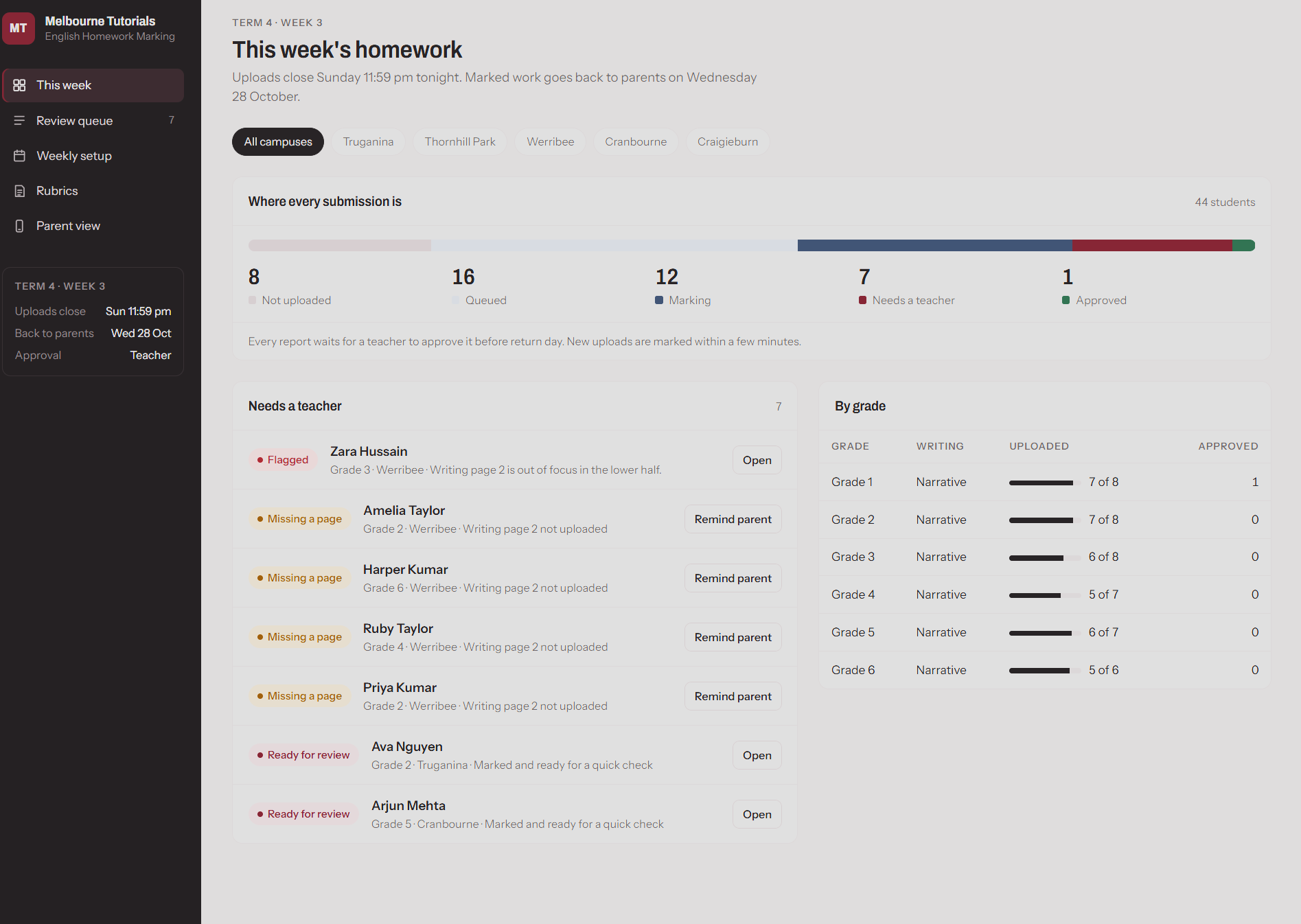
An early screen from the build. Not final.
Upcoming Important Dates
Dates set by ACER, by individual schools or by ACARA are not listed here, because we will not publish a date we cannot stand behind. Check the official source, and ask us if you cannot find it.
Parent Education Article
The notebook that does more for a selective entry result than any app
Every year we meet students who read constantly and still lose marks on verbal reasoning. The reading is not the problem. The problem is that the words pass through them. A word is met, roughly understood from context, and never looked at again, so it is never actually owned. Owned words are what verbal reasoning, comprehension and writing all draw on, and the cheapest way to build a stock of them is a notebook and a dictionary.
We call it a word book. It is a personal dictionary your child writes themselves, and the writing is the point. Copying a definition is passive. Building an entry is active, and only one of the two sticks.
What goes in an entry
Ten items, in this order. The word. Its pronunciation, if that helps. Its part of speech. The meaning in your child’s own simple words, not the dictionary’s. Two to four synonyms. Two to four clear antonyms. One sentence from the dictionary showing formal usage. One sentence your child writes themselves. The word family, where there is one. And the collocations, the words that habitually travel with it.
The eighth item is the one that does the work. A child who can write their own correct sentence with a new word has understood it. A child who cannot has only copied it.
Copying a definition is passive. Building an entry is active. Only one of the two sticks.
Where the words come from
Not from a list of impressive words. From whatever your child is already reading: comprehension passages, novels and short stories at their level, newspaper articles written for young readers, school textbooks and class discussion, teacher word lists and mock tests, and anything they listen to, a documentary, a debate, a podcast. The rule is simple. Any unfamiliar word goes in the book, and so does any familiar word being used in an interesting way.
How to organise it
Three options work. Alphabetical, which is fastest to look up. By theme, which suits writing practice, with sections for emotions, character traits, persuasion, setting and conflict. Or by week, which is what we recommend for selective entry preparation: words one to twenty in week one, twenty one to forty in week two, and so on, so that revision has a natural unit.
Aim for ten to fifteen new words a week. That is one or two a day, which sounds unambitious until you multiply it by a ten week holiday and arrive at well over a hundred owned words before Term 1 starts.
Revising it, which is where most word books die
About five minutes a day, reading yesterday’s words aloud. One short weekly test on synonyms, antonyms and sentence building. One writing challenge a week using three to five of the words in a single paragraph. And some mixing: rewrite a sentence swapping in a synonym, or run odd one out and simple analogies, which is verbal reasoning practice in disguise.
What you can do at home
Keep the target realistic and the book neat, because a messy book stops getting opened. Ask your child to explain one new word in a sentence at dinner. Put the book in the weekly homework routine rather than treating it as an extra. And praise consistency rather than quantity. A child who adds two words a day for a year finishes with seven hundred. A child who adds forty in one burst in March finishes with forty.
Enrolling, or just want to ask.
Places are allocated from a waitlist, and an Expression of Interest is the only way in. One per child, per campus.
Start an Expression of Interest →
Truganina · Werribee · Thornhill Park · Craigieburn · Cranbourne